
The Cars We Keep: Why Enthusiasts Form Lasting Connections With Their Cars
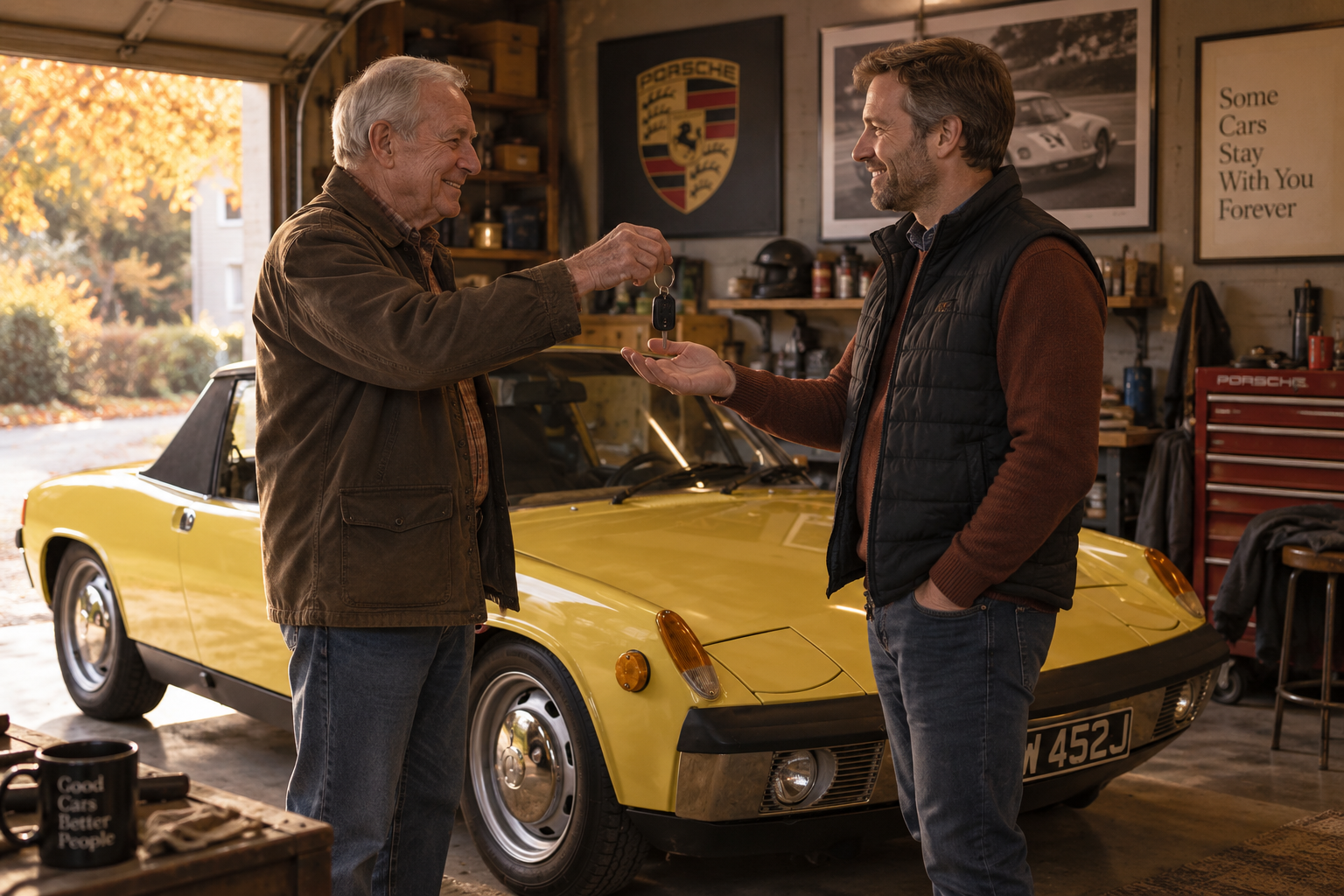
I learned to drive in an olive green Porsche 914 that belonged to my dad.
Of all the cars that have come and gone through my family's life, that's the one I continue to think about. It wasn't particularly powerful. It certainly wasn't luxurious. By today's standards, there are countless cars that are faster, more capable and easier to live with. None of that really matters to me.
I remember sitting low in the car. I remember the simplicity of the interior and learning to work the manual transmission. I remember the sound and the feeling of driving something that seemed completely different from the other cars around me. Most of all, I remember that it was my dad's car, and it was the car in which I learned how to drive.
I've wanted another one ever since.
Every so often, I'll find myself looking through listings for 914s. I picture finding the right one, preferably in that same olive green, and putting it back in my garage. Maybe I would keep it largely original. Maybe I would prepare it for occasional track use. I'm not entirely sure.
What I do know is that if I eventually find one, I suspect it will be very difficult for me to ever sell it.
And that has gotten me thinking about something that probably resonates with a lot of automotive enthusiasts.
Why are there some cars we buy, enjoy for a few years and eventually replace, while others become the cars we keep?
It's Not About Transportation
To be clear, I'm not talking about the cars most of us depend on every day.
The family SUV. The pickup truck. The minivan that somehow accumulates 100,000 miles hauling kids, groceries, sports equipment and everything else life requires. Those vehicles can certainly generate memories of their own, but their primary purpose is usually practical. We need them to do a job.
Enthusiast cars are different. Sometimes you get into a car and something about it simply feels right.
Maybe it's the seating position. Maybe it's the sound of the engine. Maybe it's the balance of the chassis or the way the steering communicates what the front tires are doing.
For some drivers, it might be the characteristics of a rear-engine Porsche. Someone else might love the predictability of a front-engine, rear-wheel-drive sports car. Another driver may become completely devoted to a lightweight mid-engine platform because of the way the car rotates and responds.
There are cars that complement our personalities or represent a particular stage in our development. Cars that make us feel confident. There are cars capable of extraordinary performance that somehow leave us cold (or intimidated), and slower cars that make a 30-minute drive memorable.
On paper, the decision about which car is "better" might seem obvious, but behind the wheel, it can be completely different.
I think that's where the idea of the cars we keep really begins.
The Car That Feels Right
As I continue thinking about my own path toward becoming a more experienced track driver, I've spent a lot of time looking at potential cars.
And, as I've written before, I've learned pretty quickly that horsepower isn't necessarily the most important consideration.
A car that inspires confidence can be much more rewarding than one that simply produces a faster lap time. Predictable handling. Feedback from the wheel, the brake pedal, and the way the seat wraps around you. The availability and cost of tires, brakes and other consumables. Perhaps most importantly, there is the relationship between the driver and the car.
I think experienced track drivers understand this particularly well.
Spend enough time around a racetrack and you'll find people who have owned much faster and more expensive cars but continue returning to one particular platform. They know how the car behaves. They know what the rear of the car will do under braking. They understand how it responds to throttle. They recognize the sounds, vibrations and little signals that tell them what the car is doing.
Eventually, that familiarity becomes confidence. And confidence can become attachment. The car stops being interchangeable with the next new model or the latest performance benchmark. It becomes your car.
That doesn't mean it has to be rare. It doesn't have to be valuable. And it certainly doesn't have to be perfect. It just has to feel right.
Sometimes the Connection Comes First
My connection to the 914 is obviously different.
I didn't fall in love with that car because I studied its specifications or compared lap times. I certainly wasn't thinking about weight distribution when my dad was teaching me to drive. The connection came first.
Only later did I begin to appreciate what made the 914 interesting as a sports car: its compact dimensions, low weight, mid-engine layout and the wonderfully mechanical and throwback nature of driving something from that era.
If I buy another one someday, I know there will be objectively better track cars available to me, but that's not really the point.
I'd be buying a connection to a memory.
My younger brother, Micah, has taken that idea in a very different direction.
Another Porsche from our father's past, his old 912, has found an entirely new life with Micah. Rather than preserving the car as a static reminder of what it once was, Micah has repurposed it into an electric racecar, with the goal of competing with it at Pikes Peak.
I love that idea because there is something fascinating about taking a car with a family history and allowing its story to continue in a completely unexpected direction.
The car is still connected to our dad. It is still connected to our childhood and our family's history with cars. But now Micah has added his own chapter to it.
An older Porsche that could have disappeared into someone's collection is instead being reengineered, tested and prepared to take on one of the most extraordinary motorsports challenges in the country. It raises an interesting point about what it actually means to preserve a car.
Sometimes preservation means restoration. Sometimes it means keeping every original bolt and piece of trim exactly as it left the factory.
But sometimes keeping a car means continuing to use it. And sometimes it means completely reinventing it.
Every Car Accumulates a Story
I suspect that if you walked through a gathering of automotive enthusiasts and asked everyone which car they would never sell, the answers would be remarkably varied.
Someone might point to a pristine collector car. Someone else might show you an old BMW with 150,000 miles. It could be a Corvette that has spent years at HPDE events. A Miata that taught someone how to drive on track. A 911 that was purchased after reaching an important career milestone. A Mustang that a father and son restored together. Or a car that simply arrived at exactly the right moment in someone's life.
The common denominator isn't necessarily value. It's the story.
Cars are unusual objects in that way. They occupy a strange space between machines and experiences. We remember where we drove them. Who was sitting next to us. The road trips. The mechanical failures that weren't funny at the time but somehow become funny years later. The first track day. The first spin. The first time we finally got a corner right.
We remember teaching our kids how to drive them. And sometimes we remember our parents teaching us. At some point, selling that car becomes more complicated than checking its market value.
When Space Changes the Equation
There is also a very practical reason enthusiasts don't always keep these cars: Space.
For most of our lives, owning another vehicle usually means making a decision about an existing one. Garages only have so many doors.
If something new arrives, something else may have to leave. I've always thought that is one of the more interesting aspects of having dedicated enthusiast space. It changes the equation.
A car doesn't necessarily have to justify its existence as the fastest car in the garage, the newest car in the garage or even the car that gets driven most frequently. It can simply be a car worth keeping. That's one of the ideas I find compelling when I think about the Garage Condo community at Motorsports Gateway.
Yes, these spaces will hold cars. But over time, I suspect they will hold something more interesting: different chapters of people's automotive lives.
There might be the dedicated track car sitting next to the vintage car someone has owned for 25 years. The new purchase next to the car that was supposed to be sold to make room for it. A project waiting for the next free weekend. Maybe a motorcycle. Helmets from past events. Photographs, trophies, tools and pieces of memorabilia whose significance makes sense only to the person who owns them.
Eventually, the space begins to tell a story. That was something I explored in the last edition of this newsletter when I wrote about garages becoming "more than four walls." The more I've thought about it, the more I believe the cars themselves are what give those spaces their real identity.
What Would You Keep?
I'm not sure whether my olive green 914 is still out there. Maybe it was restored. Maybe someone is still driving it. Maybe it disappeared years ago.
But I know what it represents to me.
And perhaps someday an olive green 914 will find its way back into my life. It probably won't be the fastest thing I could buy for the money. It won't be the easiest car to own. And if my intention is to spend time on track, there will undoubtedly be more logical choices. But logic isn't always why we choose these cars.
Sometimes it's about how a car responds when you turn into a corner. Sometimes it's the engine sitting behind you instead of in front of you. Sometimes it's the steering, the balance or the confidence that comes from knowing exactly how a car will react.
And sometimes it's because you can still picture your dad sitting next to you, teaching you how to drive.
Those are the cars that become difficult to replace. Those are the cars we keep.
