
Inside Corvette Racing: A Conversation with Team Manager Ben Bode
Championship-caliber results rarely happen by accident. They are the product of talented people, relentless preparation, and a culture committed to continuous improvement. To gain a deeper understanding of what makes Corvette Racing by Pratt Miller Motorsports one of the premier teams in sports car racing, we recently sat down with Team Manager, Ben Bode. From his personal journey in motorsports to the leadership, teamwork, and behind-the-scenes execution required to compete for wins every weekend, Ben offered a fascinating look inside one of racing's most respected organizations.
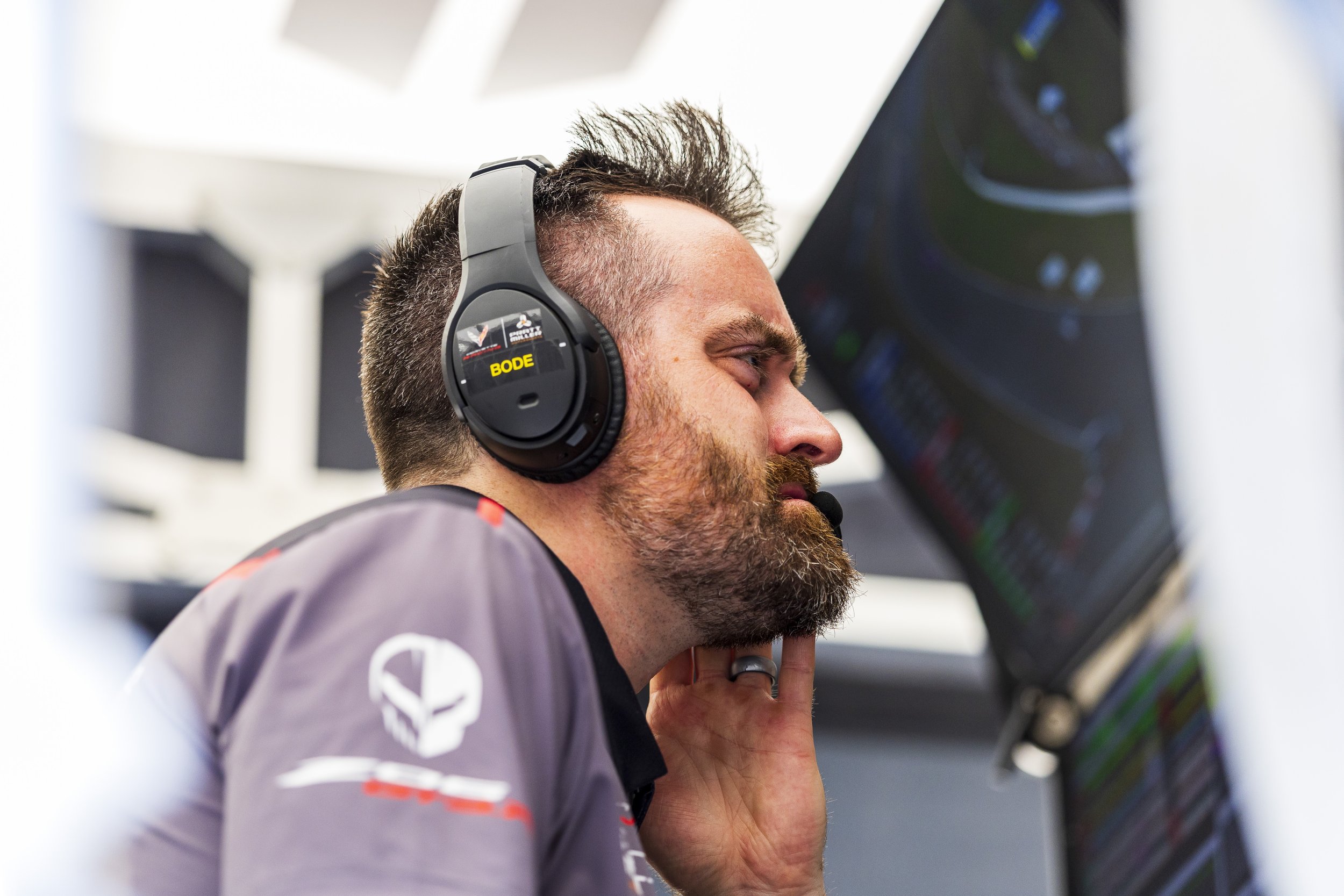
Photo courtesy of Pratt Miller Motorsports
Eli Bayless (EB): You just reached your 15th anniversary with Pratt Miller Motorsports. Congratulations. The first thing I'd like to do is walk through your background. Are you from Michigan?
Ben Bode (BB): I grew up in Kansas. I spent most of my childhood there. I've been a car nut all my life. My mom tells me I used to fall asleep with Hot Wheels clenched in my fists. And always a big Corvette nut. So, it's always been Corvettes for me. I first learned about Corvette Racing and Pratt Miller when Dale Earnhardt Sr did the Daytona 24 (2001). That was when I first really started to understand sports car racing and learn about this whole world and through that learned about Pratt Miller. Being a car guy, I looked at several schools up in Michigan, but ultimately decided to go to an in-state school, Kansas State. They've got a really nice engineering program.
Super happy with my college experience there. Fortunately for me, they had a Formula SAE team and that was an incredible experience. It took some of the concepts that we learned in the classroom and gave us a really fun, practical application. Our formula SAE team was fairly small at Kansas State. They vary in size depending on the different colleges and at that time the team was fairly small and that gave me an opportunity to learn a lot of different areas about the car. I participated in that team every year that I was in college. I really enjoyed that process. We competed up at Formula Michigan and then we also did a year or two at Formula VIR
I applied for Pratt Miller right out of school. I didn't get the job right away, but I kept at it. I wouldn't say that I was aggressive, but I didn't let them forget me. I was pretty interested in getting the role. I got very lucky that the design office manager, Gary Latham, was also a Kansas State grad. That was our initial connection. We had a really nice interview and I started in the main design office in May of 2011.
In my first year, I quickly got assigned to a project in the aerodynamics group to work on the IndyCar Aero kits and spent most of my initial time at Pratt Miller working on IndyCar. Then within the Aero Group I also worked on the Corvette, Cadillac, some road car programs. I spent a little over 12 years in the Aero group, which is most of my career here. That was a really enjoyable process. Very focused on the design and development. I like Aero because it merges the artistic creativity with the engineering and performance metrics that are required in racing.
EB: Looking back at the last 18 months,PMM earned 2025 Driver, Team, and Manufacturer championships; TF Sport (a Corvette Racing team in the FIA World Endurance Championship) just won at Le Mans; And as we approach the halfway point in this year's IMSA Weathertech season, things are trending really strong for both the #3 and #4 cars. What is that differentiating factor for Corvette Racing by Pratt Miller Motorsports that sets your team and your culture apart from your competitors and allows your team to work at such a high level?
BB: Yeah, it's always been a take no prisoners, never die attitude here.Even when we come away with a win, we have a list of things that went wrong at the event that could have been better and we sit down and review that. We're an extremely self-critical group. I think we're very fortunate that we have a lot of respect and trust in all of our teammates that allows us to have these fairly blunt conversations about things that can continue to improve. Even (after) a race that we come away from, like at Detroit, where we were the fastest in every practice session, fastest in qualifying and won the race, we still have a list of things that need to be improved for the next event. You won't see us doing cartwheels after a race win. We're focused on continuous improvement and I think that's really been ingrained in the culture here, even long before I was involved. I'm very honored to be able to help continue that.
The culture has always been extremely driven and focused on what's ahead. I think that's a really enjoyable process to be a part of.
EB: Can you tell me a little bit more about the annual rhythm of your job? For example, I'm sure that currently not only are you making lists from the past race for improvements heading into the next race, but you're also probably looking at things that will positively impact the program for next year. What does that rhythm look like over the course of 12 months?
BB: The short answer is all of that is ongoing all at the same time. It's all very continuous. I think one of the other points about our culture and our process that I think helps yield success is that we try to be as proactive as possible. So, think about heading into a race weekend: We do a lot of simulation work. We do a lot of work with the drivers on the driver simulator. We do a lot of engineering work with all our historical data to make sure that when we open the tailgates on the trucks and roll the cars out, we're already in a good starting point. That way we can make fine adjustments through the limited practice sessions that we have each weekend. Basically, we front load as much of that work as possible and that goes from the engineering side to the crew side to operations and logistics. One thing that was interesting transitioning from the Aero group to the Team Manager role is when you go wind tunnel testing and running studies in CFD (computational fluid dynamics) it's like a laboratory: You have complete control over everything. We combine CFD with wind tunnel testing. The analogy that we use is they're like a knife and fork. You don't use one and not the other. You use both in harmony with each other. You're controlling all the conditions and all the specifications, but at the racetrack is a very uncontrolled environment.
At the racetrack, there's a lot of chaos, there's changing weather, there's rain, there's contact on track, there's parts that fail, there's cautions that you can't necessarily predict. So, because we know that there's going to be that chaos, we don't fear that chaos and shy away from it. We try to prepare on the front end so that when that chaos inevitably happens, we can react and handle it well. A lot of my role is trying to make sure that all facets of the team are well prepared heading into an event so that we can react well when something unexpected happens because that's always going to happen at the racetrack.
Additionally, the more that we can rely on consistent standard operating procedures, that frees up bandwidth to be able to think one year ahead of time. So, rather than sort of scrambling and taking a reactive approach to each race, we take a very proactive approach and that allows us to feel like we're just turning a crank on a defined process. That frees up time to focus on bigger picture items for the future planning. There's going to be an evolution of the current Corvette Z06 GT3R. There's going to be an Evo kit that debuts in the near future. We need to plan for how we're going to have cars ready for that.
We're obviously always looking at driver lineups and that sort of thing. So, we need to always be relying on consistent processes that really help enable us to take on that additional work ahead of the future.
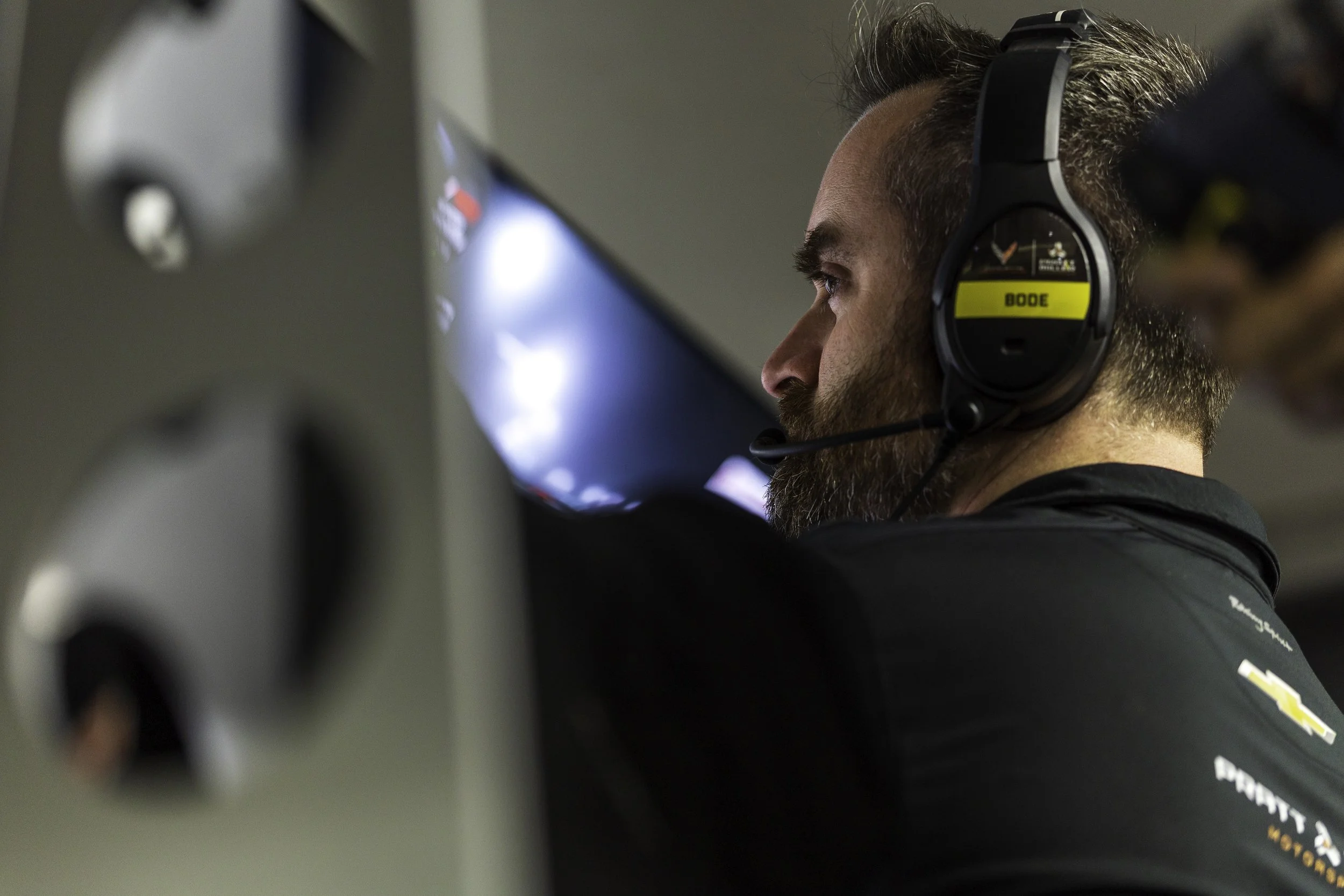
Image courtesy of Pratt Miller Motorsports
EB: When watching on TV, what we see is mostly driver focused. We do have a little bit of visibility into pit stops, tire changes, and some additional observable mechanical adjustments over the course of a race. Give me a little bit of insight into some of the wins from your team behind the wall that has had a direct impact on strong track performance this year.
BB: I've also watched several races as a fan and it's difficult to get the full context on TV. There's so much more happening behind the scenes. On the timing stand, we have more data from our cars, we also have data on timing and scoring. I'd say one of the really big things that is difficult to understand on TV is the fuel strategy. So, if we can use less fuel in a stint and potentially go one more lap in a stint, that builds a fuel advantage, which means that the next time we stop for a pit stop, we need less fuel than our competitor to fill the car, and therefore we can be in our pit box a shorter amount of time. So the more that we can minimize our time in the pits, it helps us with track position. A lot of our strategy and a lot of the engineering work goes into understanding fuel strategy and how that plays into when we make stops with the car. Different tracks will require an undercut versus an overcut. All those sorts of things don't really get captured on TV.
One interesting example of that, and it wasn't a win, but it's important for the championship points, is at the end of the (2026) Daytona 24 hours. We had strong cars all race. The #3 car had a mechanical issue that effectively put it out of contention for a win. The #4 car was still fighting but was pushed off the track with three and a half hours remaining and shuffled to the back of the field after showing strong pace for the prior 21 hours or so. We were fighting our way back up through the field. The fans can hear other competitor cars' radio transmission, and of course we can on the pit wall as well. So we are listening to other cars' radio comms. They are listening to ours. We know this. We have to be careful with what we communicate to make sure that we're not giving too much away. In that closing stint, we realized that we had a fuel advantage on the Lamborghini and the #4 car was running in fifth. Lamborghini was in fourth. They had a big gap which looked difficult to close and we thought we were going to have to settle for fifth. But as we were looking at the fuel numbers that we get through the timing and scoring data, as well as listening to their radio comms, it became pretty clear that they were going to have to do a really big fuel save to make it to the end of the race. And they were basically hoping another caution would come out in order to make it to the end.
That was the information that we needed to give our driver, Nicky Catsburg, to let him know, hey, you need to go on the attack. And our engineers worked on what fuel number he could use. The drivers actually get a readout on the steering wheel of how much fuel and energy they use every lap, so that they can make sure they're hitting the targets the engineer is giving them. And we realized that the Lambo was within reach. And we passed that car with one or two laps remaining. And we don't go to races to finish fourth. We aim to win. But if we're in a position where we can't win, every last championship point matters. And that fourth place finish gave us an advantage. In the next race, the #4 car finished third, then second at Laguna, and that's what eventually built the championship points position. That put the #4 car in the lead of the championship without having won a race. If you look back at the last several seasons in IMSA, if you average third place finishes, you'll win the championship.
Again, it's not our intent to go to races to finish a step or two off the top of the podium, but we're here to win championships and if we can continue to get consistent results like the #3 car did last season, that's the ticket to a championship. We're fighting for every single position and I think that's a really good example of some of the nuance in the race strategy, where the engineers have to be paying attention, all the way to the end of those 24-hour races to make sure we're maximizing points.
EB: Great story. I remember that overtake at Daytona with just a couple laps left. What can you tell me about your four primary full-season drivers, Antonio, Alexander, Tommy, and Nicky?
BB: First of all, we're extremely lucky to work with such a talented group. They're all absolute professionals. It always impresses me just the raw skill and how tightly packed that group is, how consistent they can be with lap times while also managing tires and managing fuel consumption and everything else. And then to have the mental bandwidth to take all that information, and also asking their race engineer for updates on overall race strategy. If I were behind the wheel, I would be completely overwhelmed with the information that's flooded in, but they're able to process all of that and ask additional questions on top of it.
They each have their different personalities. I think it's a super fun group. There's a lot of banter amongst that group, and sometimes if you light the fuse on the WhatsApp chat and get the ball rolling, your phone will just be buzzing the entire rest of the day with memes and insults and jabbing each other and everything. So we do a good job of keeping the mood light because we're always giving each other a hard time and that goes across the board. This goes back to what we were talking about earlier. There's a foundation of trust and respect in the group and that allows us to give each other a hard time and make fun of each other and keep each other honest. I think that's a really healthy part of the group and that goes drivers, engineers, crew, everybody.
Certainly there's different personalities amongst the driver group. They inevitably prefer a little bit different car setups. So as the engineers are working to set up the car, there's adjustments that we have with the suspension, the Aero, the powertrain. We'll usually start with a very similar setup and then the cars might diverge just a little bit as we get closer to the race, but we're constantly sharing information. After every single practice session, qualifying and race, we meet with the drivers and engineers from both cars, sit in the same trailer and compare notes from the session. So if something works well on one car, we may adopt it in the other car. It's very open and transparent. There's no inter-team competition. We're focused on getting yellow Corvettes to the front. It doesn't really matter what number is on the side. I'd say that's another piece of the culture that's so enjoyable. We have a lot of conversation about what's best for the overall team and there's no big egos getting in the way of making that happen.
EB: Personally, with two young kids and the huge amount of work that your role entails, do you ever get to take a car out on track? Do you enjoy track driving? What do you like to do behind the wheel?
BB: So, my personal car is a 2002 Z06. I've had that since 2015. I absolutely love it. It's incredibly reliable. I've done a handful of track days with it. I'm no professional driver. You won't ever see me behind the wheel of one of the proper race cars. I do enjoy driving. I've done several track days at local Michigan tracks with it, but I also know my place. There's a reason that we pay our professional drivers very good money to go compete because I certainly do not have the robotic precision that those guys have. I get a lot of enjoyment out of HPDE days. But I'm not competing at the top of the time charts. My place is behind the keyboard looking at data.
- - -
Ben Bode is a native of Kansas, and earned a Bachelor of Science degree in Mechanical Engineering with a minor in Business from Kansas State University. He has been with Pratt Miller Motorsports for over 15 years, and is currently the Team Manager of Corvette Racing, a role he has held since November of 2023.
